
December 29: The Christmas Octave / Saint Thomas Becket / Santo Tomás Becket
-
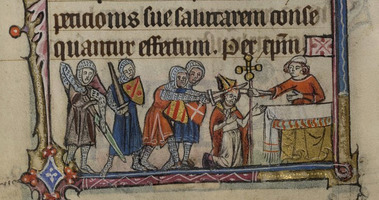
The Church celebrates the feastday of St. Thomas Becket (1118-1170) today. He was appointed first as Chancellor of England and then Archbishop of Canterbury by order of his friend, King Henry II. As Archbishop, he sided with the Pope on the respective authority of Church and state and was slain in his own Cathedral of Canterbury. He was murdered for defying the King’s desire to govern the Church by royal decree.
Whereas many of us would like a prolongation of the warm and cozy sentiments of Christmas throughout the Twelve Days of this holy season, the Church’s calendar suggests a more stark and somber response to the birth of the Savior: December 26 is the feastday of the first Christian martyr, St. Stephen; December 28 (unless it falls on a Sunday) is the feastday of the Holy Innocents, the children murdered by King Herod in and around Bethlehem; and today is the feastday of yet another martyr, St. Thomas Becket. The placement of these feastdays on the calendar at this time of year did not happen by accident.
The warmth and coziness of the Christmas that we long for lead us to think that Joseph and Mary took a leisurely trip down to Bethlehem to be “enrolled,” as if they were registering at Macy’s for their firstborn son’s birth. It’s as if they later went on a “vacation” to Egypt. The facts are these: the Emperor demanded that everyone register, put their names on the record, tell him where they lived and how much they could be taxed ... and where they could be found and punished if they did not pay their taxes; and Herod was going to kill Jesus if the family didn’t flee for safety. Along with warmth and coziness, these are also the realities of Christmas and it is good to never forget them.
***
Cada 29 de diciembre la Iglesia recuerda a Santo Tomás Becket, político y religioso inglés; Canciller del Reino de Inglaterra (1155-1162) y Arzobispo de Canterbury (1162-1170).
Este gran santo entregó la vida sometido al martirio por fidelidad a Cristo y a su Iglesia –trágicamente a instancias del Rey Enrique II de Inglaterra. Este, después de haber sido su amigo por décadas, montó en cólera y precipitó su ejecución en virtud a la férrea oposición de Becket al deseo real de controlar a la Iglesia Católica en Inglaterra. “Santo Tomas, ruega por nosotros.”