
April 10: Day of Prayer / Día de Oración
-
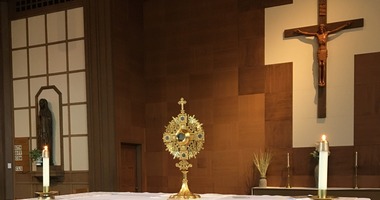
Every Thursday in our parish church we offer the opportunity for Adoration of the Blessed Sacrament as part of our weekly “day of prayer” (8:30am to 8:30pm).
Eucharistic Adoration only makes sense on the basis of our recognition that the Eucharist is substantially “God-with-us,” that is, the Body, Blood, Soul, and Divinity of Jesus Christ made present under the appearance of bread and wine. Once we really appreciate that the Eucharist is Jesus, then we can begin to hear His words echo in a Eucharistic context: “Come to me all you who labor and are burdened and I will give you rest.” (Matthew 11, 28)
All of us live busy and at times fragmented lives. Eucharistic Adoration can be an oasis in the midst of this busyness, it can remind us that we are not defined by what we do, how busy we are, or how successful or unsuccessful we are. What defines us is the love of God our Father.
Many who participate in our “day of prayer” in this way find that there is nothing quite so restful as sitting in the church and simply looking up at the monstrance. We do not have to have a particular set of prayers to say, although sometimes these are helpful. It is simply a time to rest, and a time to be with the Lord. Though the phrase is cliché, it is true, we are human beings, not human doings.
***
La Adoración del Santísimo Sacramento, también conocida como Adoración Eucarística, es parte de nuestro “dia de oración” (los jueves de 8:30am a 8:30pm).
Participamos en la Adoración de Jesucristo presente en la Sagrada Eucaristía. Y, como sabemos, la Eucaristía es el Cuerpo, la Sangre, el Alma, y la Divinidad de Jesús bajo la apariencia de pan y vino. La adoración de la Santísima Eucaristía es el proceso de venir ante Cristo en su totalidad para contemplar su grandeza y adorarlo con amor. Cuando hacemos esto, estamos en Su Presencia Real, capaces de hablar con Él en nuestra mente y nuestro corazón.
***
Uno de los santos que tenía una gran devoción a la Adoración es Santa Teresa de Jesús (1515-1582). Ella tenía una vida espiritual muy centrada en el Santísimo Sacramento. Ella, que tenía especial devoción también a la fiesta del Corpus Christi, refiere que en medio de sus tentaciones, cansancios, y angustias, “algunas veces, y casi de ordinario, al menos lo más continuo, en acabando de comulgar descansaba; y aun algunas, en llegando a el Sacramento, luego a la hora quedaba tan buena, alma y cuerpo, que yo me espanto.” La Eucaristía, tanto para el alma como para el cuerpo, es el pan y la medicina de Santa Teresa: “¿piensan que no es mantenimiento aun para estos cuerpos este santísimo Manjar, y gran medicina aun para los males corporales? Yo sé que lo es.”